


PROJECT OVERVIEW
PROJECT DETAILS
- Category Intermateriality
- Project Leader: Anna Vierlinger
- Collaborating Partner: Forschungsstelle für Kulturwissenschaftliche Studien (FoKuS), Klosterneuburg Abbey
- Project Duration: March 2026–February 2029
- Funding: Gesellschaft für Forschungsförderung Niederösterreich (GFF NÖ), FTI-Doctoral Scholarship
- Supervisors: Elisabeth Gruber (IMAREAL) and Andreas Zajic (ÖAW)
Wearables and textiles as social markers in religious communities of the early 16th century
This dissertation project examines the role of objects worn on or close to the body (wearables) and textiles as significant aspects of material culture in double monasteries of the early 16th century. The project focuses on the question of how these objects made belonging, status, hierarchy, and gender visible within religious communities, and how normative ideas related to actual practice.
The study is based on account books from selected double monasteries. It focuses on the Abbey of Klosterneuburg, the Abbey of Göttweig and the Benedictine Archabbey of St Peter in Salzburg.
What are wearables and textiles?
In this project, wearables are defined as objects that are connected to the body through their use, function, or decorative purpose. These include clothing and footwear as well as accessories, jewellery, crosses, and rosaries.
Textiles is a broader term and, in addition to clothing, also encompasses textile furnishings in monastic and liturgical contexts, such as bedding, tapestries, and altar cloths. Both groups of objects provide a means of exploring questions of status, function, gender, and social order in monastic practice.
Why double monasteries?
The study focuses on double monasteries, that is, religious communities in which men’s and women’s convents lived in the same place, according to the same rule and were subject to a shared spiritual authority. This framework allows us to examine monastic life not separately, but rather to focus on their interconnections, differences, and shared administrative structures.
Three double monasteries are examined: the Abbey of Klosterneuburg, the Abbey of Göttweig and the Benedictine Archabbey of St Peter in Salzburg from the late 15th to the early 16th centuries.
What do account books tell us?
Account books form the central source base of the project. By documenting income and expenditure, they provide insights into the acquisition, production, maintenance, repair, and allocation of wearables and textiles. In doing so, the project builds on a long-standing tradition of research at IMAREAL, that approaches account books not merely as sources for economic or administrative history, but as key artefacts of material culture.[1] Research by Gerhard Jaritz as well as more recent studies by Elisabeth Gruber on monastic material culture and monastic account books, has demonstrated the potential this type of source holds for exploring questions relating to objects, practices, social order, and the scope for everyday actions. In addition, the project draws on normative sources, such as statutes and dress regulations to examine the relationship between regulation and practice.
How do objects become visible through relationships?
Methodologically, the project builds on the Object Links research perspective developed at IMAREAL. Rather than focusing solely on the objects themselves, this approach examines the relationships between objects, people, institutions, and practices. This reveals how wearables and textiles were embedded in social, cultural, and economic contexts and how they contributed to the shaping and maintenance of monastic order.
What role does ITEM/accounts play?
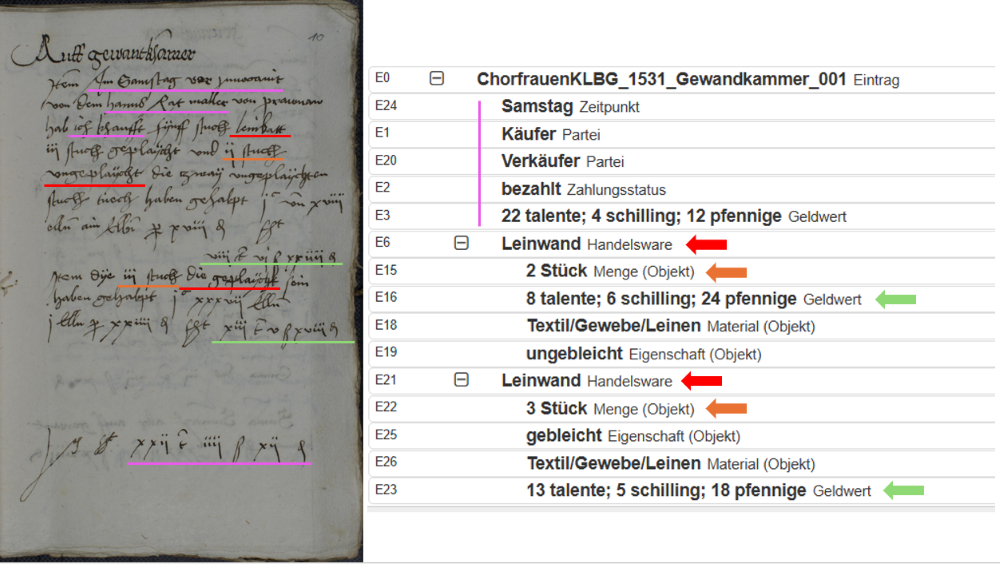
The project uses ITEM/accounts, a digital tool developed at IMAREAL for the structured analysis of historical account books, to record and analyse the source material. This enables entries relating to wearables and textiles to be systematically recorded, categorised, and linked to individuals, institutions, practices, as well as other objects.
ITEM/accounts therefore not only facilitates the processing of a large body of source material but also helps to reveal recurring patterns: for example, in the use of particular materials, the allocation of specific objects, gender-specific practices, or economic networks. At the same time, the digital recording of the data creates opportunities to visualise complex relationships between objects, actors, and institutions. Via ITEM/accounts, the project’s data are also incorporated into DiscoThings, which links visual and textual sources on material culture in a shared knowledge graph.
Project Objectives
The project views clothing, accessories, and textiles not merely as functional artefacts, but as objects that could express belonging, communicate hierarchical roles, and makes differences in status, function, or gender visible.
Building on this, the dissertation examines how social orders in double monasteries were established, stabilised, and negotiated through material objects. Particular attention is paid to gender-specific differences in the use and handling of wearables and textiles.
[1] E.g. Elisabeth Gruber, Klösterliche Sachkultur revisited: Materielle Kultur und soziale Praxis in den Rechnungsbüchern des Stifts Göttweig, in: Herbert Krammer und Christina Lutter (Hg.), Von Menschen, Dingen und ihrer Umgebung. Pragmatische Schriftlichkeit und ihr Sitz im Leben (12.–15. Jahrhundert): Jahrbuch des Stiftes Klosterneuburg. Neue Folge 27 (2026), S. 63–74; Elisabeth Gruber, Account Books as Practice. Tracing Material Culture in Monastic Communities, in: Michaela Wiesinger, Hg., Knowledge and Order. Monastic Learning and the Quadrivium, Wien 2025; Gerhard JARITZ, Zur Sachkultur österreichischer Klöster des Spätmittelalters, in: Harry Kühnel, Hg., Klösterliche Sachkultur des Spätmittelalters, Wien 1980, 147–168; Gerhard JARITZ, Die Reiner Rechnungsbücher (1399–1477) als Quelle zur Klösterlichen Sachkultur des Spätmittelalters, in: Harry Kühnel, Hg., Die Funktion der schriftlichen Quelle in der Sachkulturforschung, Wien 1976, 145–271.
Talks:
Anna Vierlinger, Widerspenstige Gewänder – Körperdisziplin und Kleidungspraxis in den Stauten der Klosterneuburger Chorfrauen (15. Jahrhundert), im Rahmen der Nachwuchstagung GegenStand. Objekte zwischen Performanz, Präsenz und Affordanz des SFB 1391 „Andere Ästhetik“ der Universität Tübingen, am 23.06.2026.
Anna Vierlinger, Im Kontobuch der Gewandkammer. Digitale Ansätze zur Erschließung von Kleidung und Textilien mit ITEM/accounts im Rahmen der Tagung Zahlen bitte? Rechnungen und Rechnungsbücher des Spätmittelalters und der Frühen Neuzeit im Fokus, am 10.11.2025.
Science to Public:
Herbert Krammer / Anna Vierlinger, Die Welt hinter den Zahlen, Vortrag im Rahmen des Formats „Bücherabende“ im Stift Klosterneuburg am 12.05.2026.